A few weeks ago, Daniel Smith told me his water heater was dying. It had served his Miami home for more than fifteen years, and a replacement element earlier in the year had only bought time.
I reminded him that this would be a great opportunity to practice what we preach, use our investments for the benefit of others, and share what we learn from the living labs we call our homes. He took that seriously. He turned the replacement into a public series, comparing five options in real time, and asked me to weigh in on which one he should actually buy.
This is my answer, with the math behind it, and why I think a water heater belongs in a conversation about housing affordability.
Why a Water Heater is a Housing Story
Over the summer, Daniel and I wrote a six-part series called The Real Cost of Staying in NYC. Its premise was simple: a home is not affordable because of its price. It is affordable, or not, because of what it costs to stay in it, month after month. That bill includes the mortgage or rent, the taxes, the insurance, the repairs, and the energy.
In the fourth week, on energy, we put it this way: the homeowner does not pay a rate, she pays a bill. And the most reliable way to lower that bill is not to argue about rates. It is to design the home so it needs less, power what remains as efficiently as possible, and keep a record of who benefited.
Water heating is a good place to test that idea. The Department of Energy calls it the second-largest energy expense in the average American home, 14 to 18 percent of the utility bill. Almost every home has one. Most are replaced about once a decade. And almost every replacement happens the same way: the tank fails, the floor is wet, it's 10 pm, and the homeowner buys whatever the plumber has on the truck. Nobody runs the numbers in that moment.
Daniel wanted to run them before the failure, in public. So did I.
The Five Options Daniel Considered
Daniel's existing unit is a 55-gallon A.O. Smith electric tank located in his garage. Over five posts he looked at:
- Whole-home electric tankless (Rheem RTEX-27): endless hot water, no tank, but a 27 kW draw every time a tap opens.
- A hybrid heat pump water heater (Bradford White AeroTherm): a tank that heats water by moving heat out of the surrounding air, like a refrigerator running backward.
- A.O. Smith's own heat pump (Voltex AL 66): staying with the brand that served the house for fifteen years.
- Rheem's heat pump (ProTerra 65): connected monitoring and leak protection.
- LG's inverter heat pump: the wild card, with a variable-speed compressor.
Daniel weighed the candidates on efficiency, resilience, warranty and service, and on what the ownership experience would look like over the next ten to fifteen years. That last criterion is the one most comparisons leave out and is often the one most poorly explained - What does it really cost over its life?
How I Ran the Numbers
There are plenty of simple calculators on the web, but I couldn't find a calculator that answered the question for his home in Miami. Most compare one year of energy at one national price. So I built a calculator to do this. Since I am not the expert on this, I asked Adam Stenftenagel at Pearl Certification, who has spent most of his life modeling home energy at city and national scale, to check the math.
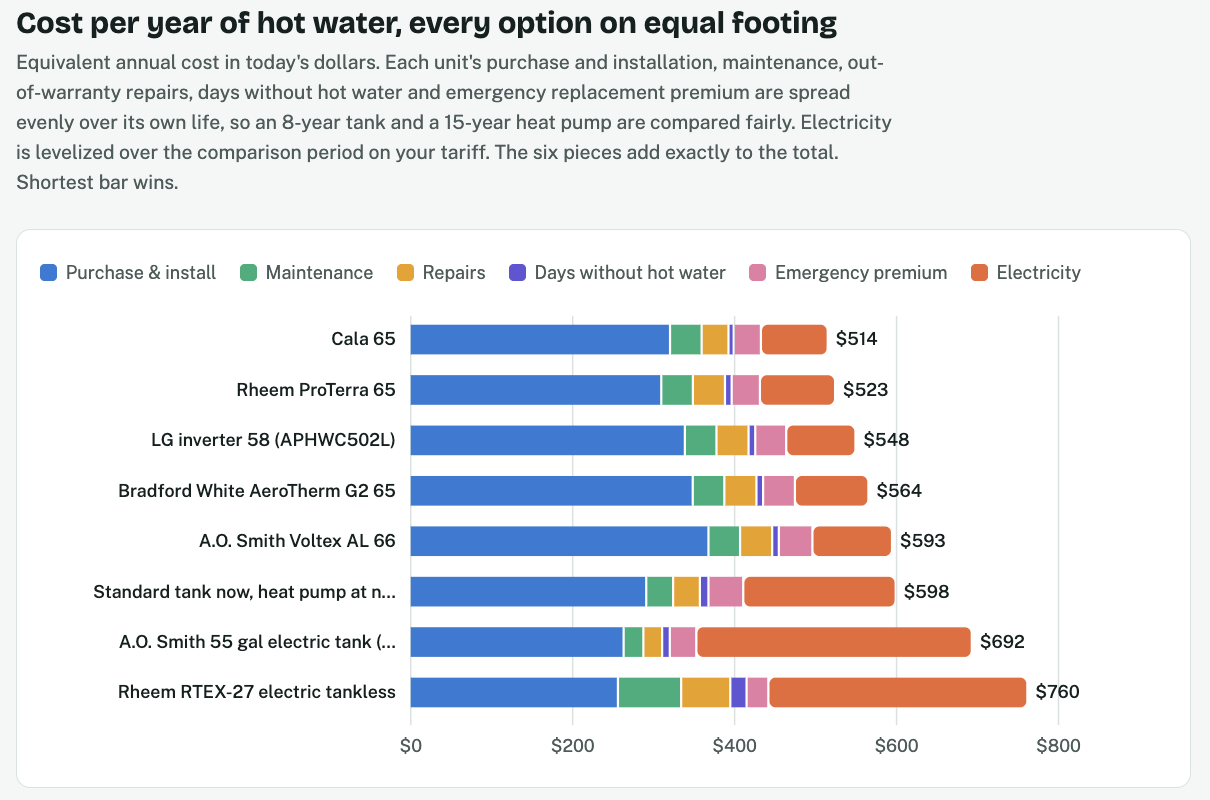
I tried to be inclusive capturing all associated costs and allocated them to per year of hot water, over that unit's own life for each option:
- CAPEX: the equipment and installation;
- Power Costs: electricity on FPL's actual January 2026 tariff, including taxes, with prices rising;
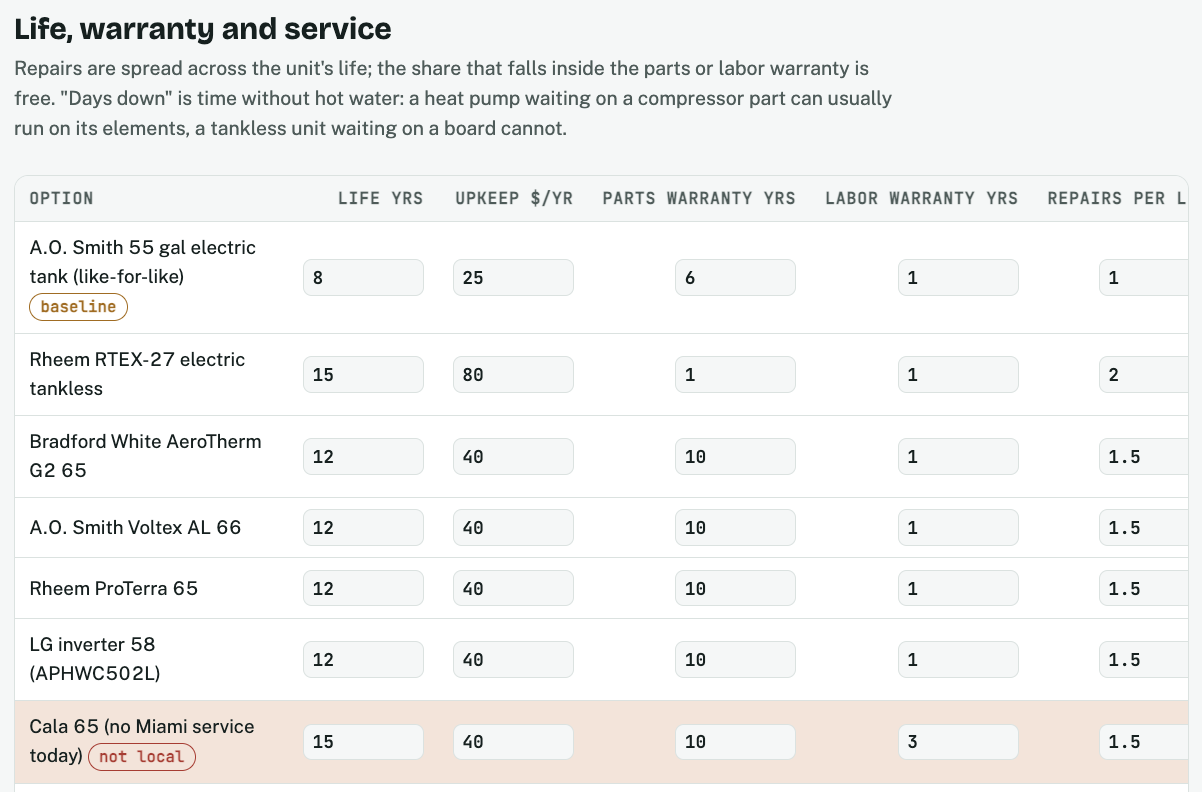
- Maintenance and Operations: upkeep, and the repairs the warranty won't cover;
- Real Resiliency Costs: days without hot water while something is fixed, and the premium for an emergency replacement;
- Worst Case Scenario: what happens when the grid goes down.
A tank that lasts eight years and a heat pump that lasts twelve are compared on equal footing, the same way a business compares assets with different lives. The calculator and a full methodology page are linked in the comments. Every assumption is there to be challenged.
What the Numbers Say
1. Miami is not the average American home
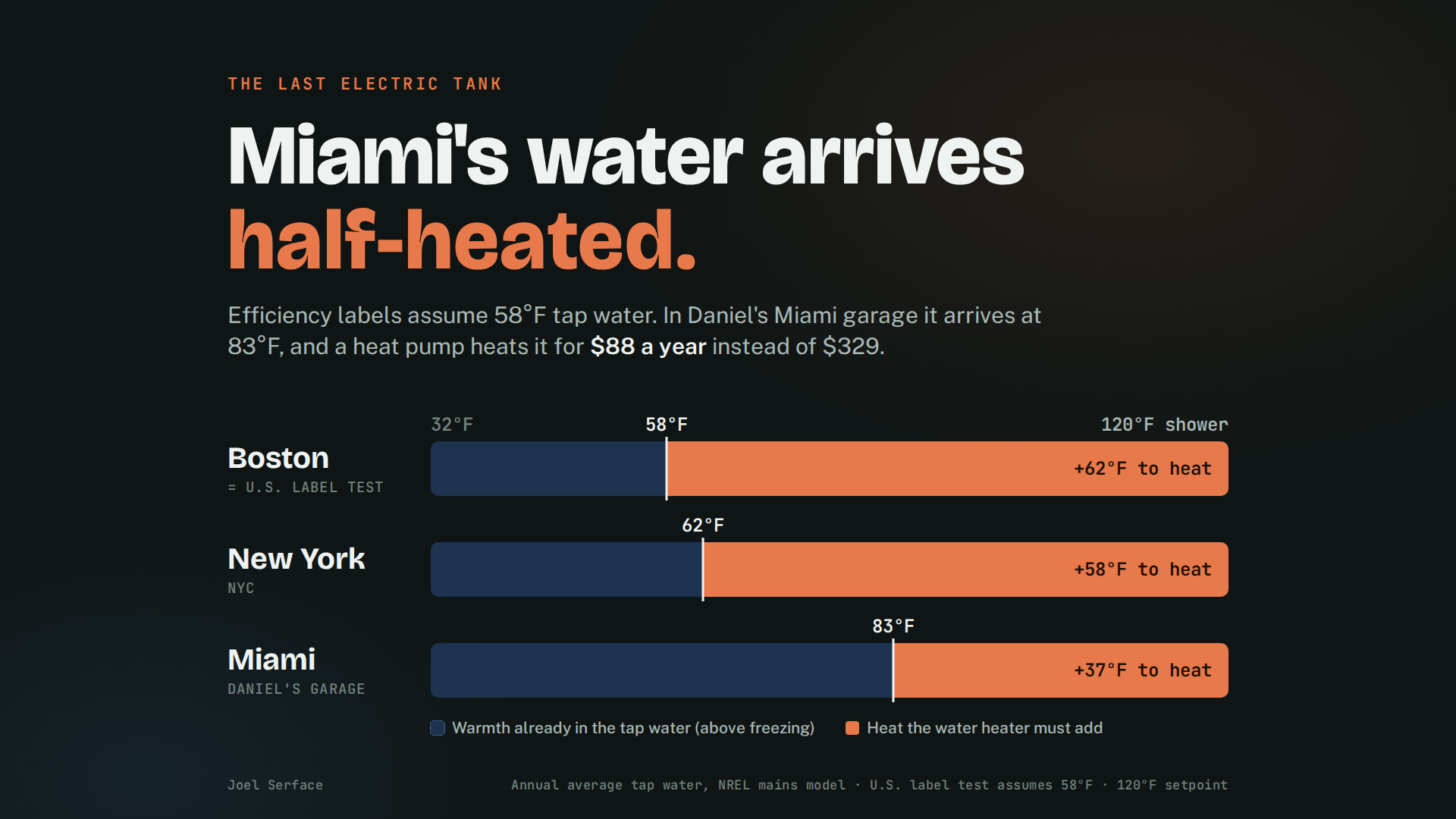
Most savings claims for heat pump water heaters assume tap water arrives at 58°F, the temperature used in the national efficiency test. In Miami it averages about 83°F. Daniel's water arrives half-heated, so every option uses less energy and every option's savings shrink.
At the same electricity price, here is how much a heat pump saves in its first year compared with a standard electric tank:
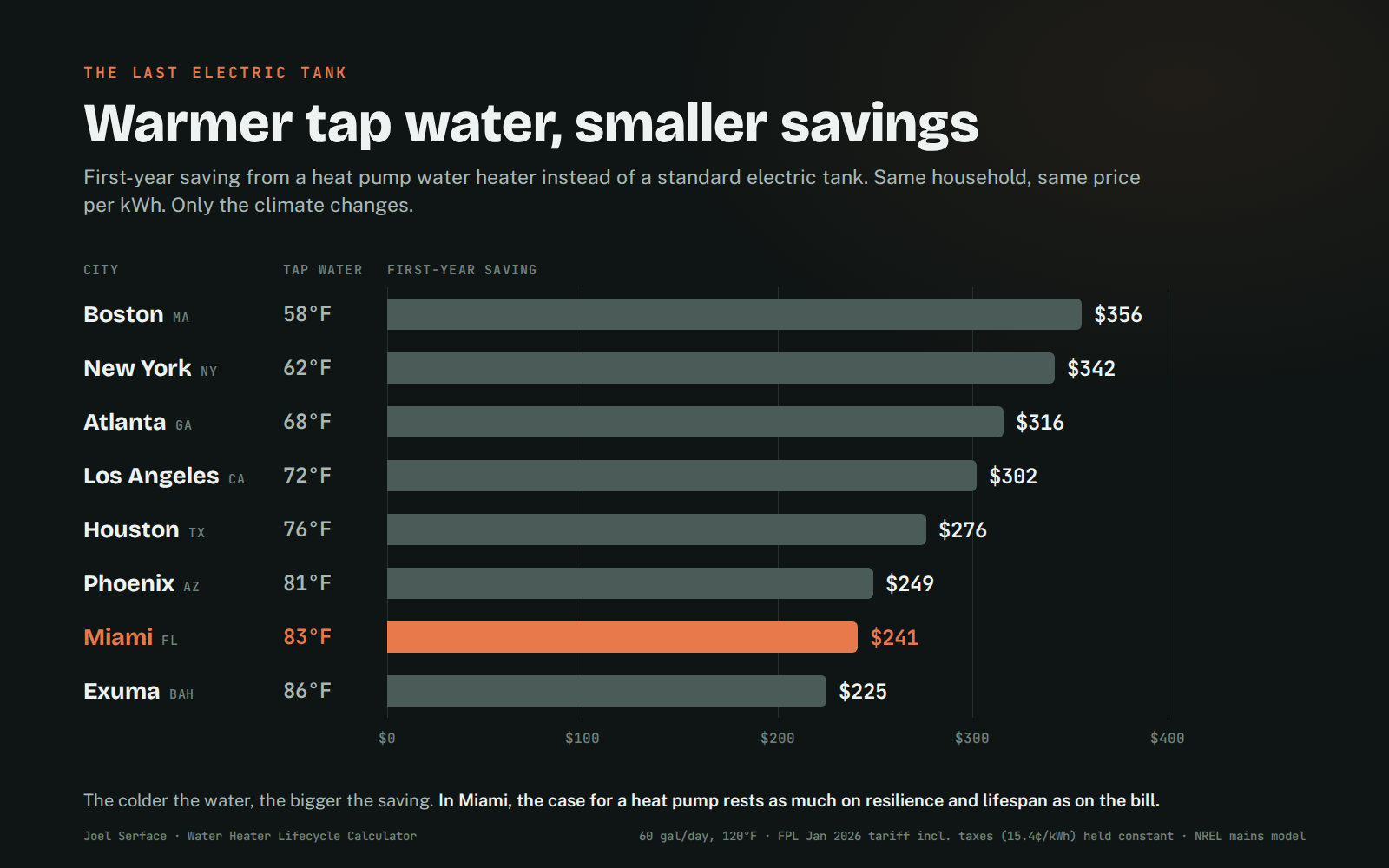
A Miami home needs about 40% less heat than the same household in Boston. New England also pays far more per kilowatt-hour, which widens that gap further.
The warm climate helps the heat pump in another way: it pulls heat from the air around it, and a Miami garage is warm year-round, so the heat pump runs near its best efficiency all year.
Adam shared that he is about to face the extreme version of this. He's building an off-grid, hurricane-hardened home in Exuma, where the water is even warmer. There, the question isn't the utility bill at all. Every kilowatt-hour comes from his own panels and batteries. A heat pump needs about 1.4 kWh a day for a household's hot water; a standard tank needs about 5.4. That difference is roughly a kilowatt of solar and a day's worth of battery he doesn't have to buy. Off the grid, efficiency isn't a savings line. It's capital avoided.
2. The real choice is now or later
Federal efficiency standards adopted in 2024 require electric tank water heaters over 35 gallons built from May 2029 to meet heat-pump-level efficiency. A new 55-gallon electric tank is one of the last of its kind. If Daniel buys one today, its replacement in eight years or so will be a heat pump anyway.
So the honest comparison isn't "tank versus heat pump." It's "heat pump now" versus "tank now, heat pump later." Buying the heat pump now costs about $75 a year less over the long run, and it starts saving immediately.
3. The heat pump wins, but by less than you've probably been told (*in Miami)
On FPL's tariff, a heat pump cuts Daniel's water-heating electricity from about $329 to about $88 in the first year. After spreading its higher purchase price over its life, it comes out about $170 a year ahead of a like-for-like electric tank and pays back in about six years.
Capitalize that the way a lender sees a lower monthly cost (7%, 30 years) and it's worth roughly $2,100 in what a buyer could afford to pay for the house. Adam made exactly this argument about his own St. Petersburg home, and it's the argument appraisers still struggle to make.
4. The brand barely matters. The setting does.
The four heat pumps differ by about $16 a year on the electric bill. The spread in installed price matters more than the spread in efficiency ratings.
What matters far more is a setting. Most heat pump water heaters ship in a hybrid mode that switches on backup electric elements to recover quickly. Field data from the Northwest found about a third of these units' energy coming from those elements. In Daniel's garage, running in heat-pump-only mode is worth about $60 a year.
Adam runs his on heat-pump-only. For two people, it uses about 300 kWh a year. The calculator predicts 260 to 300 kWh for the same use in Miami. That's the best check we have that the model is grounded in reality.
5. Time of use rewards storage, and intelligence
FPL now offers a time-of-use rate: about $0.32 per kilowatt-hour in the afternoon and evening peak, about $0.08 off-peak, after taxes. A tank, any tank, is a battery made of hot water. Heat it off-peak and coast through the peak.
That cuts both ways. A plain electric tank on a timer shifts well, which narrows the heat pump's advantage. The research is clear on what keeps it: controls that heat ahead of demand with the compressor rather than the elements. That's the work behind a set of NREL patents on predictive water heater control. At Daniel's expected prices, the heat pump still wins on time of use, $494 a year against $551.
6. Tankless is out
It pulls 27 kW the moment a tap opens. It won't start on a home battery. Per year of hot water, it's the most expensive option in the comparison.
7. Resilience seals it
A day of hot water takes about 1.1 kWh for a heat pump, about 8% of a typical home battery. A standard tank needs about 5.9 kWh, or 43% of the same battery. In hurricane country, that's the number that decides what still works on day three.
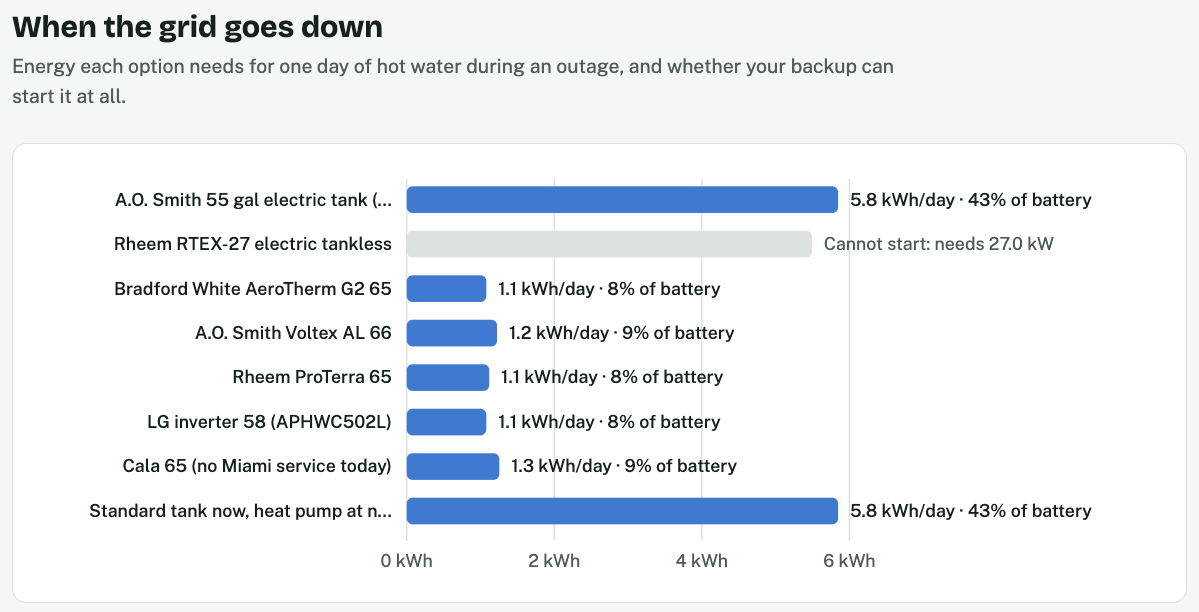 Cala 1.3. Heat pumps use 8–9% of the battery per day." width="1199" height="612" loading="lazy"/>
8. There are no incentives to lean on
FPL offers no heat pump water heater rebate. Florida's federally funded home energy rebates haven't launched. The federal tax credit ended in 2025. Daniel pays sticker price, and the heat pump still wins.
My recommendation for Daniel
Buy a 65-gallon heat pump water heater now, before the old tank fails. Set it to heat-pump-only. Choose among LG, Rheem and Bradford White on the things the efficiency label doesn't show: who in Miami will service it in year eight, how much of the labor the warranty covers, and whether the registration and service record stay with the house.
Install it on a plan, not at 10 pm. A planned swap avoids a day or two without hot water and the premium an emergency call usually carries.
The One I'd Like to See in Miami
One unit sits at the bottom of the cost chart: Cala, a Massachusetts company whose heat pump water heater learns a household's hot water habits and heats when power is cheapest or the sun is shining. Its controls are licensed from NREL. On paper it's the lowest-cost option in the model.
It just isn't sold or serviced in Miami yet.
So, an open invitation: if Cala wants to put a unit in a Miami garage and let the meter decide, we'll publish the results next to Daniel's.
What Happens Next
Adam has offered to check the math, and the methodology is public for anyone else who wants to.
Daniel will choose, install, and share what the unit actually uses. We'll compare it against what the model predicted.
That's the point of doing this in the open. A water heater is a small decision. But it's the same decision, repeated in every home, every decade, usually at the worst possible moment. Get the economics into the home's record before the failure, and the 10 pm decision becomes a planned one.
Use less. Power what remains. Prove who benefited. It works for a water heater, too.
The calculator, its methodology, and Daniel's full series are linked in the comments.
@Daniel Smith @Adam Stenftenagel